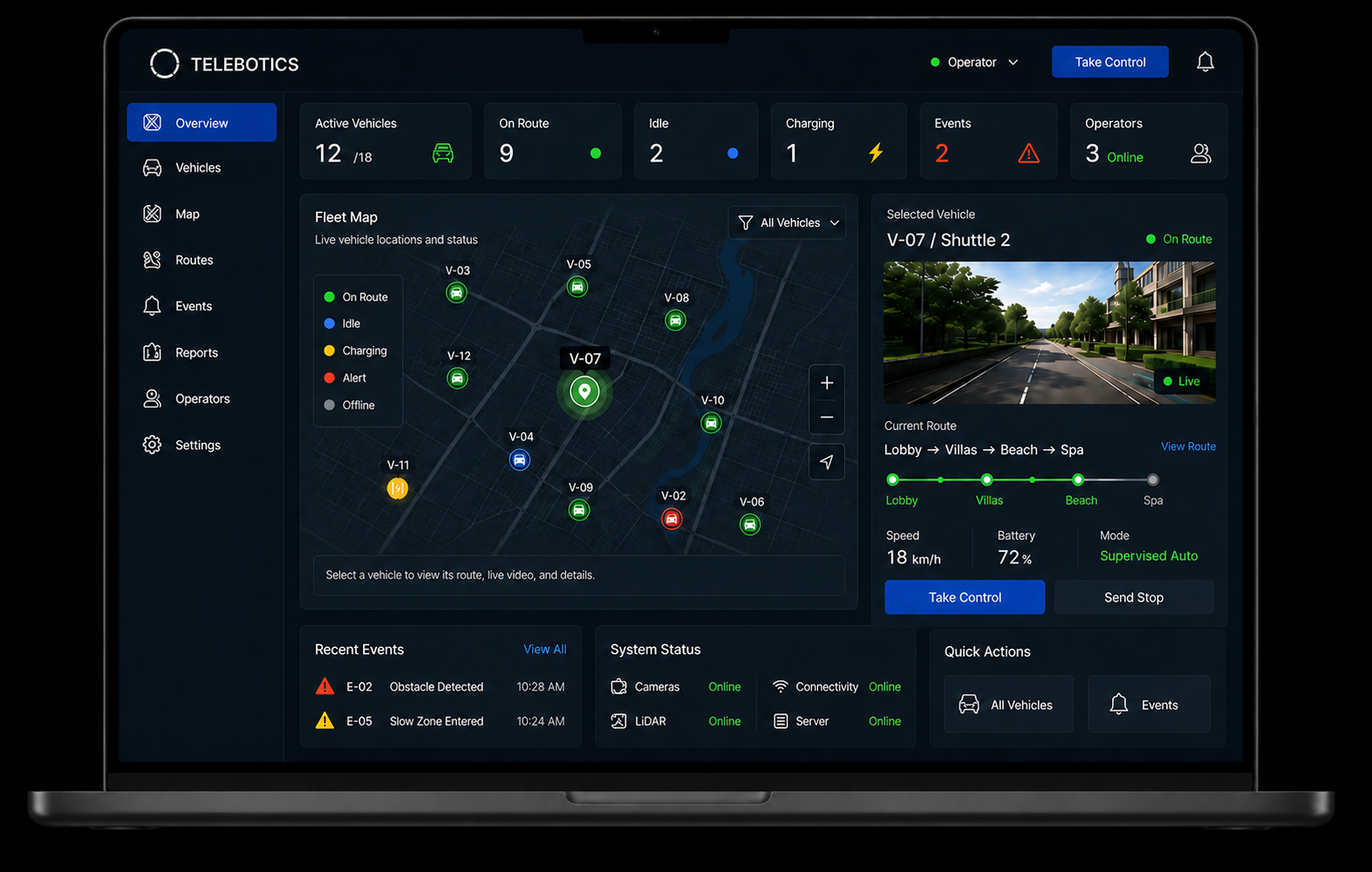
Operate More Fleet Vehicles With the Same Team
Remote operation and automation designed to increase utilization and reduce cost per vehicle over time.
Supported by
Why Fleets Need Better Coverage and Utilization
Coverage Gaps Are Growing
Many fleet operations struggle to maintain consistent coverage due to staffing constraints, limited operating hours, and rising operational complexity.
Utilization Is Too Low
Fleet vehicles often sit idle due to staffing limits, overtime constraints, and fixed shift schedules, driving up cost per operating hour.
Controlled Environments Are Ready Now
Campuses, parking operators, and private properties already operate repeatable routes, making them ideal for remote supervision and gradual automation.
A Practical Way to Run Fleets More Efficiently
Retrofit, Not Replace: Upgrade existing fleet vehicles with minimal downtime, no need to buy new vehicles or change workforce structures.
Designed for Fleet Operations: Built for security patrol, parking enforcement, and campus operations running on repeatable, controlled routes.
Remote Supervision + Safety Automation: Enable remote operation supported by onboard safety systems to improve coverage and consistency.
Built to Improve Over Time: Start with remote operation today and gradually increase automation to improve utilization and reduce cost per operating hour.
How the System Works
Remote Operation Platform: Secure, multi-camera dashboard that allows trained operators to supervise and operate vehicles remotely.
Onboard Safety System: Real-time monitoring with automatic braking, collision alerts, and safe-stop behavior.
Fleet Integration Layer: Compatible with existing vehicles through CAN-bus or actuator interfaces.
Autonomy Roadmap
-
Key Features
Tele-Drive
Emergency Stop
Collision Alert & Video Telemetry
Typical Use Cases
First-Mile Sorting Carts Inside DCs
Warehouse Or Plant-Yard EVs
Gated-Campus Vehicle Repositioning
-
(adds to Level 1)
Key Features
Lane-Keep Assist At Low Speed
Adaptive Speed / Stop-And-Go
OTA Diagnostics & Software Updates
Typical Use Cases
Campus Mail Vans & Utility Buggies
Industrial-Park Service Carts
Curb-Side Delivery Pods On Bike Lanes
-
(adds to Levels 1 & 2)
Key Features
Path-Planning On Mapped Routes
Auto Return-To-Base / Docking
Dynamic Obstacle Evasion (LiDAR + Vision)
V2X Messaging With Gates & Crossings
Typical Use Cases
Security Patrols Around University Grounds
Neighborhood Parcel Drop-Off Vehicles
Micro-Transit Shuttles In Low-Speed Zones
-
(adds to Levels 1–3)
Key Features
Map-Free Navigation (SLAM-Based)
Fleet AI & Mission Scheduler
Self-Charging / Battery-Swap Docking
Single Operator Supervises ≥ 5 Vehicles
Typical Use Cases
Urban Delivery Corridors
Closed-Campus Logistics Fleets
Smart Yard / Port Drayage With Zero Drivers
Where Telebotics Works
Security Patrol & Parking Enforcement: Extend coverage and improve consistency without adding on-site shifts.
Campus & Corporate Fleets: Support patrol, escort, and facilities operations across controlled grounds.
Industrial & Logistics Sites: Improve utilization and safety without heavy upfront investment.
Scalable Operations: Start with a small number of vehicles and expand as operations and confidence grow.